

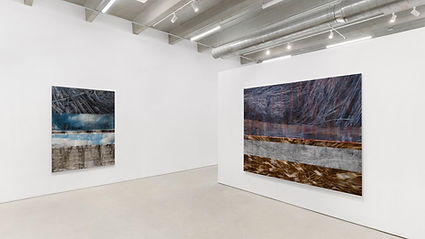
László von Dohnányi, Feel the breeze, 2026, oil on canvas, 78 ³/₄ x 102 ¹/₄ inches inches (260 x 200 cm)
László von Dohnányi: Far Lands
April 11 - May 23, 2026
Wednesday - Saturday, 11am - 6pm
800 NW 22nd Street, Miami, FL 33127
Andrew Reed Gallery is pleased to present Far Lands, German-born, London-based artist László von Dohnányi’s second solo exhibition with the gallery.
Far Lands takes its title from one of the most infamous glitches in Minecraft. In the game’s early versions, players who travelled far enough from the world’s origin would encounter a terrain-generation error known as the ‘Far Lands’: a zone where the underlying mathematics of the world began to collapse. Rolling hills and coherent biomes gave way to impossible vertical escarpments, stretched and fragmented blocks, razor-sharp cliffs, and jittering, unstable formations that felt at once corrupted and cosmic. The horizon dissolved; the world no longer behaved as it should.
In this exhibition of large-scale oil paintings, the ‘Far Lands’ become both metaphor and method. The works explore landscape not as a fixed site to be depicted, but as a meta-subject shaped by mediation. Drawing imagery exclusively from online sources – video games, films, 3D scans, satellite views, and drone footage – the paintings reflect how contemporary experience of the environment is increasingly filtered through technological systems. Images often precede lived encounter, arriving pre-assembled and encoded with structures of circulation, power, and control.
Rather than offering a single, stable viewpoint, the paintings construct spaces that feel overlapping, unsettled, and in flux. Earlier compositions remain partially visible beneath subsequent layers of paint, creating surfaces where multiple perspectives coexist and compete. Scenes drift in and out of legibility, as if buffering or failing to fully render. The result is a landscape caught in transition: not fully natural, not entirely synthetic.
For example, in the painting Touch Grass, the dominant vista is a screengrab from the 2002 sci-fi thriller Signs, specifically the scene in which the characters first enter a crop circle created by unknown forces. The image of cornfield plants bent in an unnatural manner evokes a distinctly unsettling feeling. The crop circle motif carries strong connotations, particularly within online culture, where it is often associated with conspiracy theories and speculative narratives. Beneath and alongside this central image are additional vistas drawn from different source materials. Together, they form a fragmented whole, an intentional inconsistency in which multiple visual languages are compressed into a single space. At first glance, it is not immediately clear what the viewer is looking at. The images chosen for these paintings often depict thresholds; unstable moments or scenes that embody tension, transition, or juxtaposition.
This instability resonates with the thinking of Hito Steyerl, particularly her essay In Free Fall: A Thought Experiment on Vertical Perspective, in which she describes a contemporary condition of “free fall.” Steyerl argues that the stable, grounded viewpoint associated with Renaissance linear perspective, and with the political idea of a centered, sovereign subject, has collapsed. In its place emerges a condition of vertical disorientation shaped by aerial surveillance, drone warfare, satellite imaging, and algorithmic mapping systems. Vision is no longer anchored by a fixed horizon or embodied observer; instead, it operates within a networked, machinic field in which images circulate operationally and are detached from human scale and orientation.
The paintings in Far Lands inhabit this condition of perceptual instability. They stage landscapes in which the ground feels provisional and the horizon uncertain, as though the viewer were suspended within Steyerl’s “free fall”: no longer securely positioned but caught within a fragmented visual regime where perspective itself has become unstable.
Von Dohnányi is interested in how belief is constructed in an era where images often precede experience, arriving already assembled, mediated, and encoded with systems of power and circulation. Meaning arises from both the technologies that produce these images and the seemingly neutral landscapes they depict, creating a tension between how the world is seen and what is being seen. Painting in his practice acts as a slow, embodied counterpoint to the speed and authority of digital images. By translating mediated landscapes into oil, Von Dohnányi aims to develop a visual language that acknowledges technological ways of seeing while resisting their totalizing logic.
The paintings in this exhibition explore the idea of the threshold, liminal environments charged with the quiet tension of a world in the process of becoming something else. They dwell in contradictions: construction and growth, natural and artificial, stability and constant flux. Clouds drift at the edge of earth and space. Agricultural fields, shaped into patterned forms by human hands, hover between the wild and the architectural. Wetlands exist in suspension between land and sea. In the painting Feel the breeze, for example, three separate images of a wetland are thrust together. A hovering drone shot of a Reed is overpainted with a photographic vista that traces the gradual transition from water to land, next to view sourced from a blog. Although the images depict the same site, the different technologies through which they are captured encode the scene with distinct layers of information, shaping how the landscape is seen and understood.
Von Dohnányi thinks of his painting as process-led, an enquiry into painting itself and an extension of “screen space.” Drawing on digital imagery, he slows the image down by substituting mechanical processes with manual labor, embedding it with the idiosyncrasies of the hand. The act of painting becomes performative. A mimetic process in which the hand assumes the role of the machine. Using rulers and other low-tech tools, he produces marks that echo the streaks and linear striations of printing processes and the flickering instability of the screen. Lines are sometimes added like redactions or overwritten data. At other times they are carved into the surface through the removal of paint, recalling deletion or the decay of information. Images are frequently painted, erased and overpainted, leaving fragments of earlier scenes visible beneath the surface. More recently he has incorporated a wider range of processes and textures, including frottage, which he thinks of as a form of analogue scanning that records the surface or “skin” of objects.
Painting here operates as a deliberate counterpoint to the speed and ubiquity of digital imagery. Through accumulation, deletion, and reworking, each surface bears the evidence of time and touch. Meaning arises in the tension between how the world is seen and what is being seen, between the systems that produce images and the landscapes they claim to represent.
In Far Lands, landscape becomes a site of psychological and cultural inquiry. Like the glitch from which it borrows its name, the exhibition reveals what happens when the structures that organize vision begin to falter, when the terrain of perception itself begins to break apart, opening onto something unstable, uncanny, and newly possible.


Installation photography courtesy of Zachary Balber